
The 2026 Melbourne Cup is fast approaching, and anticipation is already building among punters preparing for Australia’s most famous horse race. Set to take place at Flemington Racecourse, this year’s event has Melbourne Cup betting markets starting to form early, with Melbourne Cup odds beginning to shift as trainers confirm entries and form lines become clearer.
This page is your home for everything related to Melbourne Cup betting in 2026. Early fixed-price markets are emerging, and odds movement will continue right up to race day. Now is the ideal time to compare Melbourne Cup odds, track leading contenders, and understand how to bet on the world’s richest handicap race. Check the table below for the latest prices as they update:
| Melbourne Cup Winners Odds 2026 |  |  |  |
|---|---|---|---|
| #Runner 1 | TBA | TBA | TBA |
| #Runner 2 | TBA | TBA | TBA |
| #Runner 3 | TBA | TBA | TBA |
| #Runner 4 | TBA | TBA | TBA |
| #Runner 5 | TBA | TBA | TBA |
| #Runner 6 | TBA | TBA | TBA |
Widely known as the ‘Race That Stops a Nation’, the Melbourne Cup has been a centrepiece of Australian sport since its first running in 1861. Each year, more than 100,000 spectators attend Flemington, with millions more tuning in around the world, and the event remains a public holiday in Melbourne due to the cultural importance of this horse race.
The race is run over two miles, features up to 24 runners, and carries an $8 million prize pool, making it one of the most prestigious handicap races globally. In the 2025 edition, Half Yours claimed victory under jockey Jamie Melham, who became the first woman to win the Melbourne Cup since Michelle Payne’s historic triumph in 2015.
The 2026 Melbourne Cup will be run on Tuesday, 3 November 2026.
Before placing your 2026 Melbourne Cup bets, keep these key tips in mind to help identify value in one of racing’s most unpredictable events.
Identifying the top offshore racebooks is the best way to get the best Melbourne Cup prices and live odds. Sites such as BetNow and BetOnline offer everything from 2026 odds to expert tips. What’s more, they even offer attractive sign-up bonuses to help your money go even further.
Although the Melbourne Cup “sweeps” are very popular in Australia amongst friends, workplaces, and parties, participating in a sweep is not as exciting as placing your own strategic wagers. Choose the amount of your bet, the race number if you are betting the Melbourne Cup undercard as well as the Melbourne Cup itself, and the horse number or numbers involved.
Everyone wants to find the best horse to bet on the Melbourne Cup, but it’s not something that is easily done. Doing your research is key to success. In terms of Melbourne Cup bonus bets, we’d advise looking around our recommended sportsbooks providers and finding the right one for you.
Like most races, the Melbourne Cup bet types include win, place, and show betting, as well as exacta and trifecta wagering. Different markets from North America, Europe, and Asia may offer different wagering opportunities than those in Australia itself. If betting in Australia or the United Kingdom, try each-way betting, where a lone bet can cover a horse finishing in the top three, and sometimes in the top four depending on the bookmaker and size of the field, which for the Melbourne Cup should be substantial.
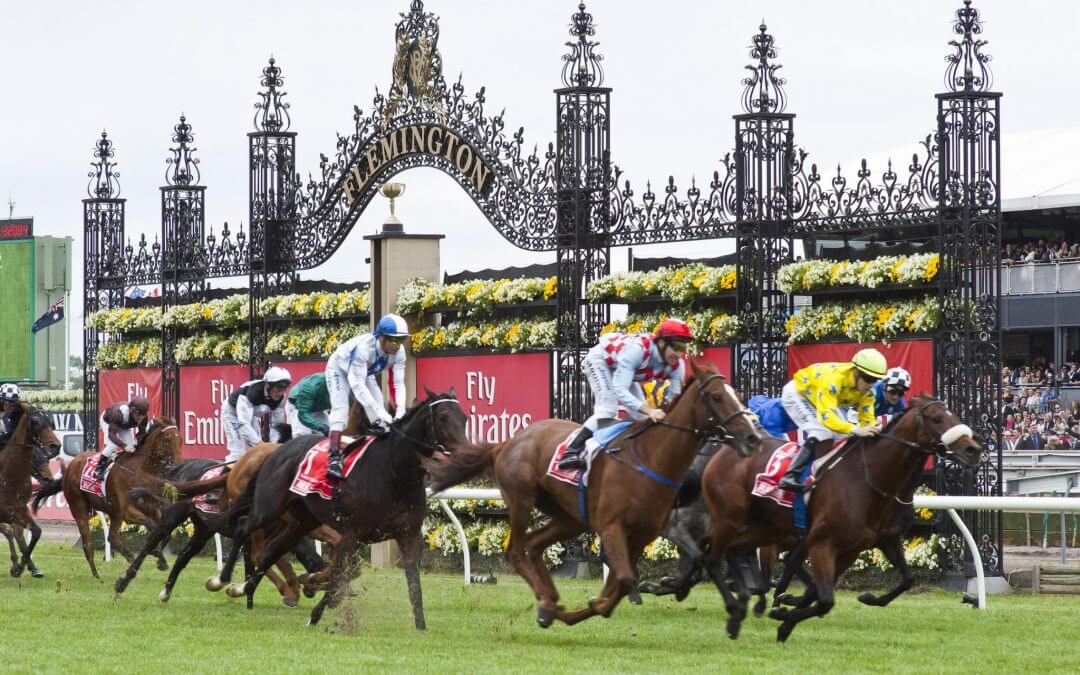
First run in 1861, the Melbourne Cup has grown from a local handicap into one of the most prestigious horse races in the world. The inaugural winner, Archer, defeated a field of 16 runners and returned the following year to win again, setting an early benchmark for excellence that still defines the race today.
By 1875, the Melbourne Cup had settled into its now familiar position on the first Tuesday in November, a tradition that has endured for well over a century. One of the most extraordinary runnings came in 1890, when a record 39 horses lined up and Carbine carried 145 pounds, or 66 kilograms, to victory. That performance remains the greatest weight-carrying feat in Melbourne Cup history.
The early 20th century produced some of the race’s most enduring legends. Phar Lap’s dominant win in 1930 cemented his status as a national hero during the Great Depression, and his preserved body remains on display at the Melbourne Museum as a symbol of the Cup’s cultural importance.
In 1968, Rain Lover won by eight lengths, matching Archer’s 1862 record for the largest winning margin, before successfully defending his title in 1969. No horse, however, has matched the achievements of Makybe Diva, who became the only three-time Melbourne Cup winner with victories in 2003, 2004, and 2005. Her dominance earned her more than $14 million in prize money and lasting recognition, including bronze statues at Flemington Racecourse and elsewhere in Australia.
Women have also played a defining role in Melbourne Cup history. Sheila Laxon became the first female trainer to win the race in 2001 with Ethereal, followed by Gai Waterhouse’s victory with Fiorente in 2013. On the track, Michelle Payne made history in 2015 when she became the first female jockey to win the Melbourne Cup aboard Prince of Penzance. That legacy continued in 2025, when Jamie Melham rode Half Yours to victory, becoming the first female jockey to win the race since Payne’s landmark triumph.
For much of its history, the Melbourne Cup was dominated by locally trained horses, with overseas participation limited by travel and quarantine constraints. That changed in the early 1990s, when international challengers began targeting the race more seriously. Irish trainer Dermot Weld ushered in a new era in 1993 when Vintage Crop became the first internationally trained Melbourne Cup winner, a feat he repeated in 2002 with Media Puzzle.
International success continued throughout the 2000s and 2010s. Notable foreign-trained winners include Delta Blues from Japan in 2006, Americain from France in 2010, Dunaden from France in 2011, and Cross Counter from the UK in 2018. Dunaden’s victory was one of the closest finishes in Melbourne Cup history, edging Red Cadeaux by a nose. Red Cadeaux, a UK-trained stayer, became a cult figure after finishing runner-up three times across four Melbourne Cup starts.
Overseas runners have remained competitive in recent editions. Twilight Payment, trained in Ireland by Joseph O’Brien, won the 2020 Melbourne Cup, adding to the strong international influence on the race. More recently, Australian-trained horses have reclaimed the trophy, with Gold Trip winning in 2022 and Without A Fight following up in 2023.
Today, the Melbourne Cup remains a public holiday in Melbourne and a global betting spectacle, watched by millions worldwide and continuing to define endurance, strategy, and racing prestige as attention turns toward the 2026 Melbourne Cup.

The Melbourne Cup is well known for rewarding punters who look beyond the favourite. The results below show the return from a minimum $2 win bet in recent years and highlight why Melbourne Cup betting often delivers strong value on mid-range and long-priced runners.
2025: Half Yours $12
2024: Knight’s Choice $23
2023: Without A Fight $8.20
2022: Gold Trip $21
2021: Verry Elegant $9
2020: Twilight Payment $8
2019: Vow and Declare $11
2018: Cross Counter $9
2017: Rekindling $14
2016: Almandin $11
2015: Prince of Penzance $101
2014: Protectionist $8
2013: Fiorente $7
2012: Green Moon $20
2011: Dunaden $8.50
2010: Americain $13
2009: Shocking $10
2008: Viewed $41
2007: Efficient $17
2006: Delta Blues $18
The 2015 Melbourne Cup remains one of the most famous betting results in race history. Prince of Penzance stunned the nation at $101 with Michelle Payne aboard, making her the first female jockey to win the race. That remarkable story was later told in the feature film Ride Like a Girl and perfectly captures how the Melbourne Cup commands national attention each year, from schools to workplaces, as the entire country stops to watch.
The 2025 Melbourne Cup once again highlighted how much betting value can be found by looking beyond local sentiment. While many Australian punters continue to favour locally trained runners, international contenders remain a major factor and were again heavily backed in 2025. Savvy Melbourne Cup betting strategies often focus on these overseas runners, particularly as markets adjust closer to race day.
Wagering turnover on the Melbourne Cup itself typically sits at around A$100 million, with total betting across the four-day Flemington Carnival reaching as high as A$450 million. These figures reflect the race’s massive appeal and the scale of liquidity in Melbourne Cup odds markets. With the 2026 Melbourne Cup approaching, similar betting volumes are expected as punters track early markets, monitor international form, and react to odds movement in the lead-up to the first Tuesday in November.

